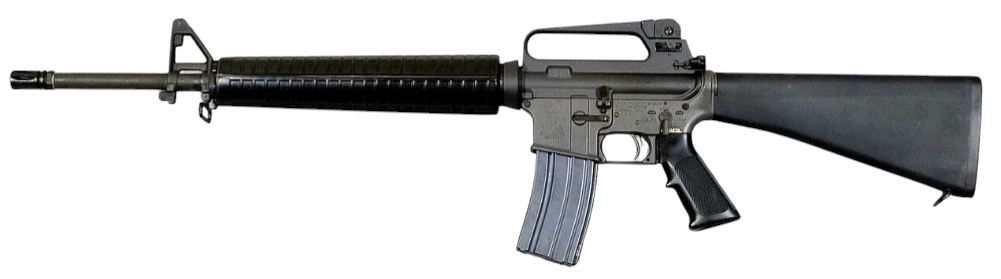
In the years that followed the Vietnam War, opportunities for improvement in the M16A1 became evident. The M16A1 lacked sights that were easily adjusted, and while a rugged and lightweight for combat was not a particularly accurate platform. Marine Corps Lieutenant Colonel David Lutz would be the program manager for M16 improvement, and his recommendations and partnership with Colt engineers would lead to the creation of the M16A2. Adopted as standard in 1983 with issue beginning in 1984, the M16A2 would usher in tremendous performance improvement for the M16 family of rifles. By the late 1990s the accuracy of M16A2s would even displace the M14 as the primary National Match competition rifle, a feat that many well-regarded marksmen would have never thought possible considering the rifle’s relatively small .223 caliber.
Lieutenant Colonel David Lutz explains the genesis of the M16A2.
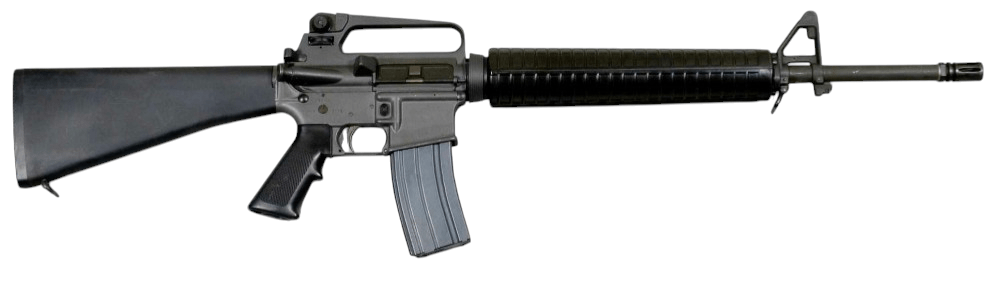
M16A2 Improvements
- Easily adjustable 1/2 Minute-of-Angle rear sight
- Front sight post upgraded to a square type
- Heavier profile barrel with faster 1-7 twist rate to stabilize heavier bullets (like the 62 grain NATO SS109 / M855 )
- Redesigned, more durable handguards and angled delta ring for easier removal
- Lengthened stock with better grip
- Added brass deflector to prevent hot brass from hitting left handed Marines
- Flash hider redesigned with a closed bottom to reduce muzzle climb and dust signature
- Automatic fire replaced with three round burst feature



Marines firing the M16A2. The M203 grenade launcher, first fielded on the M16A1 in the later years of the Vietnam War, would be attached underneath the M16A2 as shown at right (USMC).
 USMCWEAPONRY.COM